
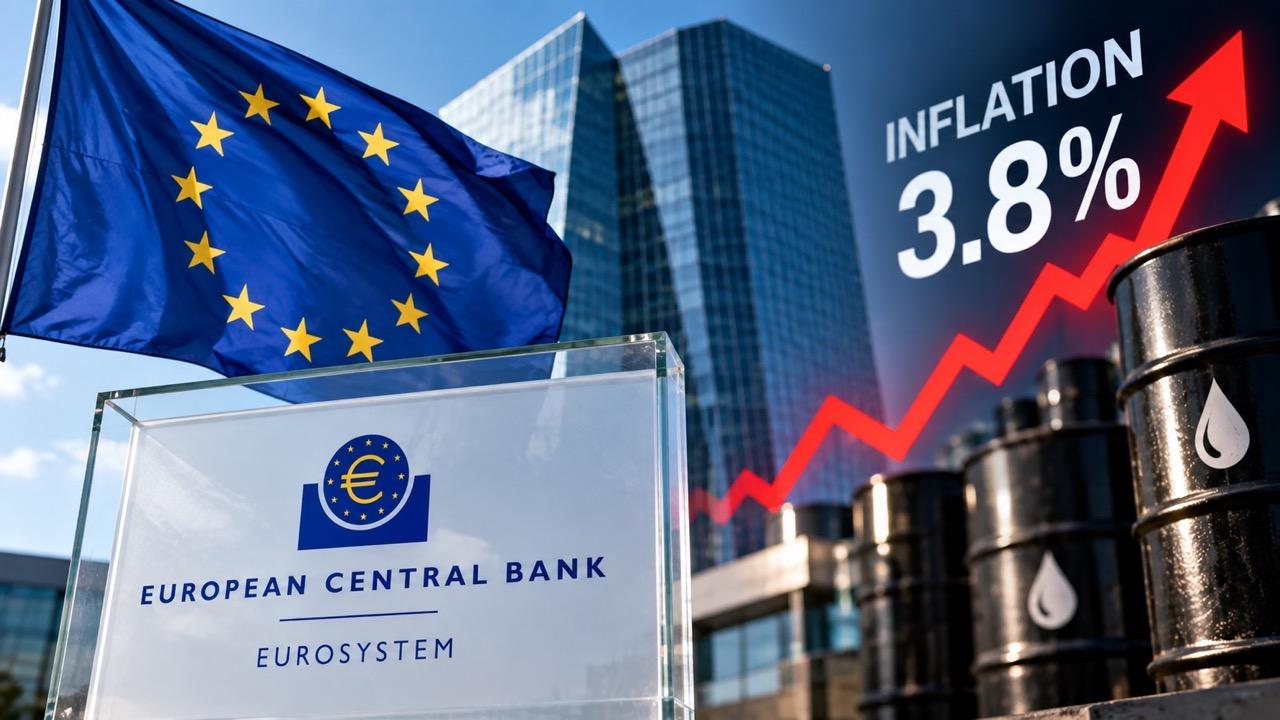
- Eurozone inflation accelerated more than expected in September, adding pressure on the European Central Bank after energy prices pushed headline inflation to its highest level in three years.
Eurozone inflation accelerated to 3.8% in September, up from 3.2% in August and above the 3.6% economists had expected, according to preliminary Eurostat data reported by Bloomberg on Oct. 2. The increase marks the highest inflation rate in the euro area in roughly three years and puts price growth substantially above the European Central Bank's 2% target.
The Bloomberg report highlighted the stronger-than-expected reading as energy prices continued to work through the European economy. The acceleration follows a sharp increase in energy costs linked to the ongoing conflict in the Middle East. Eurostat had already recorded euro area inflation at 3.2% in August, up from 2.9% in July, with energy contributing increasingly to the overall increase.
The September figure therefore represents another significant step higher rather than a one-month reversal of an otherwise stable trend.
Check out Wealthier Today's Wage Inflation Calculator to see how your wage has held up compared to inflation.
Energy Prices Drive Eurozone Inflation Higher
Energy has become the dominant source of the renewed inflation pressure. Eurostat's preliminary September figures show energy inflation at 18.8% year over year, while services inflation was 3.2%. Food, alcohol and tobacco prices rose 1.4%, while inflation for non-energy industrial goods was 1.1%.
That composition is important because the sharp increase in headline inflation is being driven primarily by energy rather than an equivalent acceleration across all categories.
The increase follows months of higher energy prices as disruptions to Middle Eastern oil supplies and shipping routes have affected global energy markets. Wealthier Today's recent oil-price coverage has tracked how crude prices and supply disruptions have increasingly influenced inflation expectations.
The previous Eurostat release showed energy inflation rising to 14.3% in August from 10.3% in July, while services inflation actually declined to 3.0%. Inflation excluding energy and food stood at 2.4% in August.
The latest data indicate that the energy shock has intensified further. The ECB has already responded to the inflationary environment. At its Sept. 10 meeting, the central bank raised all three key interest rates by 25 basis points, taking the deposit facility rate to 2.5%, the main refinancing rate to 2.65% and the marginal lending facility to 2.9%, effective Sept. 16.
ECB Faces Higher Inflation and a Complicated Growth Outlook
The September inflation reading arrives after the ECB had already acknowledged that the Middle East conflict was creating sustained price pressure. In its September projections, the ECB estimated that headline inflation would average 3.0% in 2026, before declining to 2.5% in 2027 and 2.1% in 2028. The latest monthly reading is therefore already above the central bank's full-year projection for 2026.
The ECB had also projected inflation excluding energy and food at 2.5% in 2026, 2.6% in 2027 and 2.3% in 2028. Policymakers have been monitoring whether the energy shock begins producing broader effects through wages, services and inflation expectations.
So far, wage pressures have remained comparatively contained. ECB data showed annual compensation-per-employee growth slowing to 3.3% in the second quarter from 3.5% in the first quarter. The central bank also said longer-term inflation expectations remained around 2%.
That leaves the ECB facing a difficult combination of elevated headline inflation and an economy that has shown some resilience. Eurostat reported that euro area GDP increased 0.6% quarter over quarter in the second quarter, after no growth in the first quarter.
Recent manufacturing data have also shown stronger activity. The euro zone's manufacturing PMI rose to 52.9 in September, its fastest pace of expansion in more than four years, according to Reuters. The September inflation report now gives policymakers another indication of how severely the energy shock is feeding into consumer prices. The key issue for the ECB will be whether the increase remains concentrated in energy or begins spreading more broadly through underlying inflation.
For markets, the data add another layer to the outlook for European interest rates, government bonds and the euro. Higher inflation can keep monetary policy tighter for longer, while elevated borrowing costs can weigh on households and businesses.
The ECB has said it will continue to make decisions on a meeting-by-meeting basis, taking account of incoming inflation data, the economic outlook and the transmission of monetary policy.