

- Several established companies are trading at valuation multiples well below levels investors have historically paid, creating a very different opportunity set from the expensive end of the stock market.
The US stock market remains broadly expensive by historical standards, but that does not mean every high-quality company is trading at a premium. Morningstar said in September that its US equity coverage was trading at roughly a 9% discount to its composite fair-value estimates as of Aug. 31.
However, that discount is heavily concentrated in a small group of mega-cap stocks, including Alphabet, Broadcom, Microsoft, Meta Platforms, Amazon and others.
For investors searching for undervalued stocks, the more interesting question is whether a company's current valuation is below what investors have historically paid for the business while the underlying franchise remains intact.
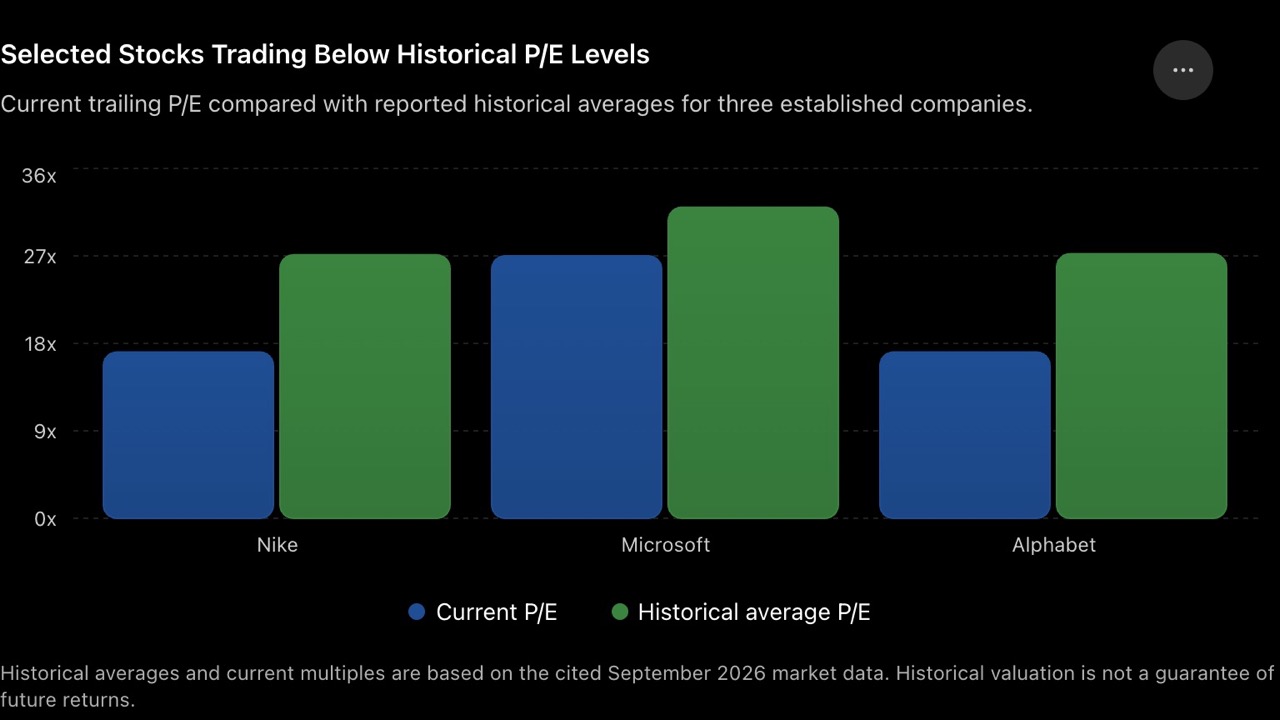
Selected Stocks Trading Below Historical P/E Levels
Current trailing P/E compared with reported historical averages for three established companies.
Technology Stocks Still Offer Some Valuation Discounts
Microsoft Corp. (NASDAQ: MSFT)
Microsoft Corp. (NASDAQ: MSFT) is one of the clearest examples. The stock has recently traded around 27 times earnings, compared with a five-year average of about 32 times, according to data cited by the Motley Fool. Morningstar has also described Microsoft as moderately undervalued relative to its $600 fair-value estimate.
Microsoft's valuation discount is particularly notable because the company continues to generate substantial growth from Azure and artificial intelligence.
Alphabet Inc. (NASDAQ: GOOGL)
Alphabet Inc. (NASDAQ: GOOGL) is another major technology company trading well below its historical valuation. A September analysis put Alphabet's P/E around 17 times, roughly 38% below its 10-year historical average of 27.21 times.
Alphabet's valuation case is supported by multiple businesses rather than a single growth narrative. Search and advertising remain its financial engine, while Google Cloud, AI infrastructure, and newer AI products provide additional avenues for growth. Investors have also been paying closer attention to Alphabet's capital allocation.
Broadcom Inc. (NASDAQ: AVGO)
Broadcom Inc. (NASDAQ: AVGO) presents a different version of the same theme. Morningstar recently described Broadcom as trading at a 26% discount to its fair value, while its AI semiconductor business continues to expand rapidly.
That does not mean Broadcom is traditionally cheap on an absolute P/E basis. Its valuation still reflects substantial expectations for AI infrastructure spending. The more relevant point is that the stock's current valuation has fallen relative to Morningstar's assessment of its long-term earning power.
Meta Platforms Inc. (NASDAQ: META)
Meta Platforms Inc. (NASDAQ: META) also remains on the list of large technology companies where valuation has compressed relative to intrinsic-value estimates. Morningstar previously put Meta at a 16% discount to fair value, although the firm noted that its uncertainty around future AI-driven growth remained significant.
The valuation story is therefore closely tied to whether Meta can turn its enormous AI infrastructure spending into higher advertising efficiency, new products and additional revenue.
Consumer, Industrial and Dividend Stocks Add Another Layer
Nike Inc. (NYSE: NKE)
Nike Inc. (NYSE: NKE) provides one of the clearest historical-valuation discounts in the group. Nike's P/E was around 17 times in late September, compared with a reported 10-year historical average of roughly 27 times. Another historical valuation dataset puts the current multiple at the bottom end of Nike's recent valuation range.
The discount reflects real problems rather than simply market neglect. Nike has been dealing with weaker sales, margin pressure and a lengthy turnaround. Wealthier Today's previous Nike earnings coverage detailed some of the concerns facing the athletic-apparel giant.
PepsiCo Inc. (NASDAQ: PEP)
PepsiCo Inc. (NASDAQ: PEP) is another established company trading near the low end of its historical valuation range. A recent analysis put its forward P/E at roughly 15, with shares trading at the lower end of PepsiCo's multi-year valuation band. The company also recently recorded its 54th consecutive annual dividend increase.
The catch is that PepsiCo's discount coincides with weaker North American snack performance, meaning the lower multiple reflects more than a broad market selloff.
Hormel Foods Corp. (NYSE: HRL)
Hormel Foods Corp. (NYSE: HRL) trades at an even lower forward multiple of about 14 times earnings, compared with the low-20s range it historically commanded, according to recent valuation analysis. Its 5.57% dividend yield adds to the income appeal, although weaker retail sales show why investors are demanding a lower valuation.
Genuine Parts Co. (NYSE: GPC)
Genuine Parts Co. (NYSE: GPC) trades at roughly 16 times forward earnings, below the high-teens to low-20s range that has historically characterized the NAPA parent. The company is also preparing for a planned separation that could change how investors value its businesses.
Clorox Co. (NYSE: CLX)
Clorox Co. (NYSE: CLX) has also appeared repeatedly on recent undervalued-stock screens. Morningstar included Clorox among its 10 most undervalued companies from its Best Companies to Own list in September.
Otis Worldwide Corp. (NYSE: OTIS)
Otis Worldwide Corp. (NYSE: OTIS) similarly combines a mature business with recurring service revenue and a discounted valuation. Morningstar recently calculated that Otis was trading at a 33% discount to its $105 fair-value estimate.
LPL Financial Holdings Inc. (NASDAQ: LPLA)
Finally, LPL Financial Holdings Inc. (NASDAQ: LPLA) offers exposure to the expanding independent financial-adviser market. Morningstar included LPL among its recent wide-moat stocks trading at attractive valuations, while its balance-sheet and operating metrics provide a different profile from the consumer and technology names above.
The common thread across these companies is not that every stock is guaranteed to rebound to an old valuation multiple. Historical multiples can remain depressed for years when earnings deteriorate or a company's competitive position changes.
Instead, the valuation gap becomes more interesting when paired with durable brands, recurring revenue, strong cash generation, competitive advantages, or credible paths to earnings recovery.