
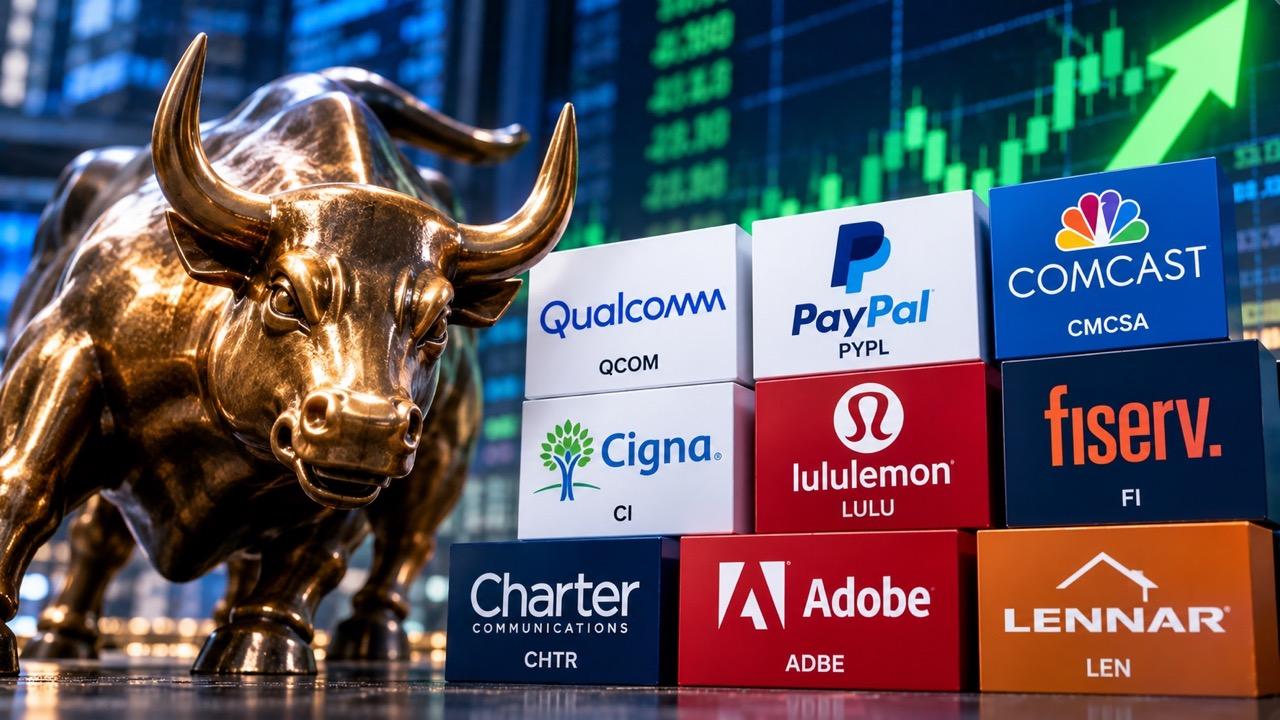
- After a year dominated by AI and mega-cap technology stocks, some beaten-down companies are trading at valuations that could leave room for a recovery if earnings, margins, or investor sentiment improve. Here are 10 stocks Wealthier Today is watching in September 2026.
The US stock market is not uniformly expensive. Morningstar said in September that the US market was trading at roughly a 9% discount to its composite fair-value estimate, although the undervaluation was concentrated outside a handful of mega-cap stocks.
A separate September screen from Investing.com identified Lululemon, Fiserv, Charter Communications, PayPal, EPAM Systems, FIS and Cigna among S&P 500 companies with modeled fair-value upside of at least 25% and low or medium uncertainty.
Wealthier Today's shortlist adds several other names where valuation has fallen relative to the underlying business, including Qualcomm, Comcast, Adobe and Lennar.
The stocks below are not ranked by expected return. Instead, they represent different value situations — from beaten-down technology and consumer names to cash-generative telecom, healthcare and housing companies.
10 undervalued stocks Wealthier Today is watching
1. Qualcomm Incorporated (NASDAQ: QCOM)
Qualcomm is one of the more interesting ways to get exposure to AI without paying the valuations attached to the largest AI stocks. The shares closed at $194.26 on Sept. 24, giving the company a market capitalization of roughly $207 billion and a trailing P/E around 22.6, according to StockAnalysis.
The bigger potential catalyst is Qualcomm's diversification beyond smartphones. At its 2026 investor day, the company raised its fiscal 2029 non-handset revenue target to $40 billion and set a target of more than $15 billion in data-center revenue by fiscal 2029. It also lifted its automotive revenue target to $10 billion.
The risk is that investors have already started pricing in some of that diversification, while Apple's move toward internally developed modem technology remains a headwind.
2. PayPal Holdings, Inc. (NASDAQ: PYPL)
PayPal remains one of the clearest turnaround/value candidates in the payments sector. The stock closed at $52.60 on Sept. 24, with a market capitalization around $45 billion and a trailing P/E of about 9.9.
Investing.com's September valuation screen calculated 61.4% potential upside to its fair-value estimate for PayPal, placing it among the most deeply discounted S&P 500 names in that model.
The opportunity depends heavily on execution. PayPal's second-quarter revenue reached $8.68 billion, up 4.75% year over year, while management raised full-year adjusted EPS guidance to $5.38, according to TIKR's summary of the results.
The biggest question is whether PayPal can stabilize branded checkout growth and margins while maintaining its enormous payments ecosystem.
3. Comcast Corporation (NASDAQ: CMCSA)
Comcast has become one of the market's more obvious cash-flow value plays. Shares recently traded around $22, while FinanceCharts showed Comcast at roughly 7.2 times earnings and a dividend yield near 6%.
A Sept. 24 analysis from Trefis noted that Comcast generated nearly $18 billion of free cash flow over the preceding 12 months, equivalent to a free-cash-flow yield of about 22% based on its market value.
The problem is broadband growth. Comcast has been cutting prices and dealing with competition from fixed wireless providers, leaving investors questioning whether the company's enormous cash generation can remain durable. If broadband stabilizes, however, the valuation leaves considerable room for sentiment to change.
4. The Cigna Group (NYSE: CI)
Cigna combines a relatively low valuation with an improving earnings picture. FinanceCharts listed Cigna at about 11 times earnings and 8.4 times EV/EBIT, while Investing.com's September screen calculated 55.9% modeled fair-value upside.
The company also reported second-quarter revenue of $71.7 billion, up 7% year over year, and raised its 2026 outlook. That combination makes Cigna interesting because the valuation does not require an extraordinary growth rate to justify a rerating.
The principal risk is the healthcare sector itself, including regulation, medical-cost trends, and uncertainty around pharmacy-benefit management.
5. Lululemon Athletica Inc. (NASDAQ: LULU)
Lululemon is arguably the highest-risk turnaround on this list, but its valuation reset is difficult to ignore. Investing.com's September screen assigned Lululemon 74.6% potential fair-value upside, the second-highest figure in its S&P 500 screen.
The market's skepticism is understandable. Lululemon recently cut its full-year revenue and profit forecasts, while its second-quarter revenue fell 4% to $2.42 billion and adjusted EPS declined to $2.92 from $3.10 a year earlier.
The potential upside case therefore depends on a stabilization of North American demand, improved product momentum, and successful execution under new CEO Heidi O'Neill. This is not a low-risk value stock. It is a recovery situation.
6. Fiserv, Inc. (NYSE: FI)
Fiserv has experienced one of the most severe valuation resets among major financial-technology companies. A September analysis found the stock trading around 10 times earnings versus substantially higher industry and peer multiples, while its broader valuation screen rated the company as potentially undervalued.
Investing.com's model calculated 69.6% potential fair-value upside for Fiserv. The problem is that the discount exists for a reason. Fiserv lowered its 2026 outlook, and investors are concerned about execution, leadership changes, and the company's transformation program.
That creates a classic value-investing setup: significant potential if management restores confidence, but a meaningful possibility that the low multiple reflects structural problems rather than temporary pessimism.
7. Charter Communications, Inc. (NASDAQ: CHTR)
Charter is another heavily discounted communications company where the market appears to be pricing in a difficult operating environment. Investing.com's September screen calculated 66% fair-value upside for Charter.
The investment case centers on the company's broadband network, mobile expansion, and enormous existing customer base.
The challenge is competition. Cable operators face pressure from fiber providers and fixed wireless alternatives, while maintaining broadband pricing becomes harder when consumers have more choices. Charter therefore represents a potentially attractive value situation for investors willing to wait for the competitive environment to stabilize.
8. EPAM Systems, Inc. (NYSE: EPAM)
EPAM offers a different type of turnaround opportunity. The software-services company has been pressured by changes in corporate technology spending and the broader transition toward AI-assisted software development. Yet Investing.com's September valuation model still assigned EPAM 59.3% potential fair-value upside.
The opportunity is that AI could ultimately increase demand for technology modernization rather than eliminate it. Companies still need engineers and consultants to integrate AI into existing systems, migrate infrastructure and redesign applications.
The risk is that AI automation could put pressure on traditional software-engineering headcount and pricing before the new demand fully materializes.
9. Adobe Inc. (NASDAQ: ADBE)
Adobe is one of the more interesting large-cap technology value cases after the market spent much of 2026 questioning whether generative AI could undermine its software franchise. FinanceCharts showed Adobe among its value stocks at roughly 13.7 times earnings, while its stock had suffered a major decline from previous highs.
More recently, Adobe shares had rebounded 24.4% over three months as investors reassessed the company's AI position. Adobe also reported strong recent operating results, with AI-related products becoming an increasingly important part of the company's growth story.
The valuation opportunity therefore depends on Adobe proving that AI will expand its addressable market rather than commoditize its core creative and document software.
10. Lennar Corporation (NYSE: LEN)
Lennar is the cyclical value play on the list.
The homebuilder's third-quarter 2026 earnings showed the pressure clearly: net income fell to $284 million from $591 million a year earlier, while new orders declined 9%.
Yet Lennar continues to generate substantial housing volume and has maintained a relatively conservative balance sheet. It ended the quarter with $1.2 billion of cash, repurchased $256 million of stock and reduced its debt.
Management also said construction costs per square foot had fallen 6% year over year and that the company's cycle time had reached a record-low 116 days.
The catalyst is ultimately housing affordability and interest rates. Lennar expects 22,000 to 23,000 fourth-quarter deliveries but reduced its full-year 2026 delivery target to 80,000-81,000 homes because of continued rate pressure.
That makes LEN a more cyclical bet than the other names on this list, but potentially an interesting one if mortgage rates eventually decline.