
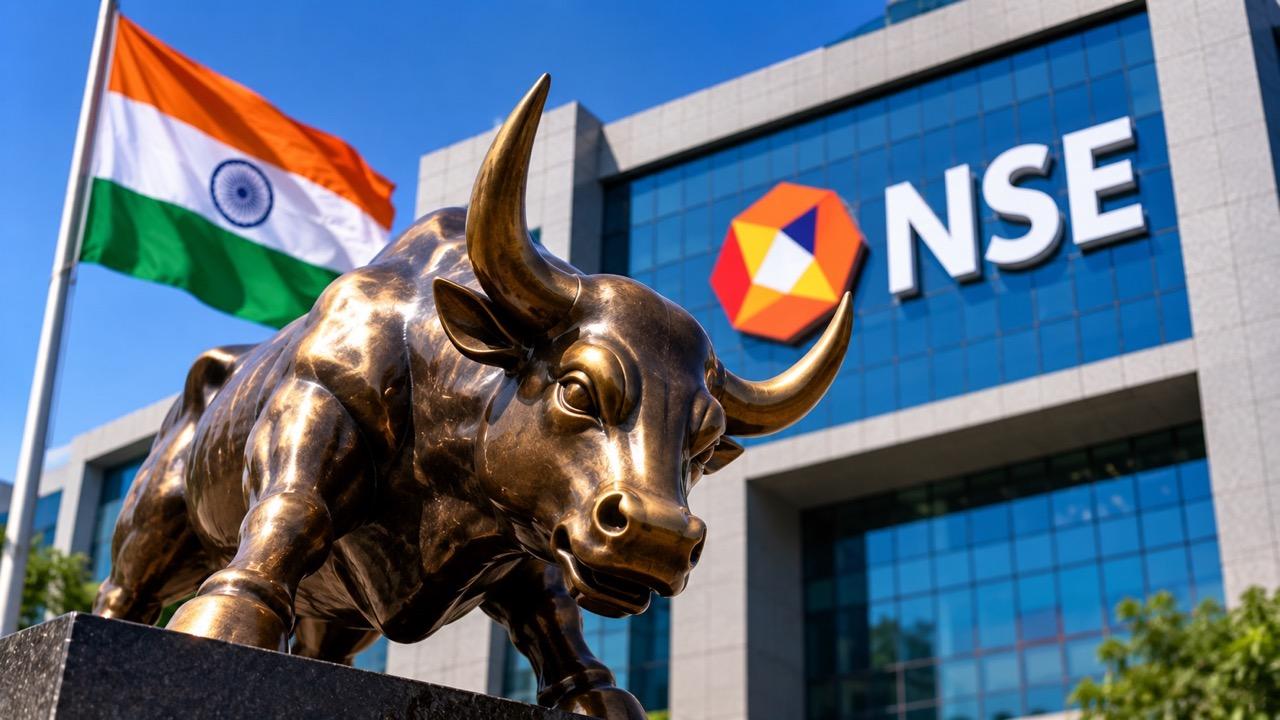
- India's National Stock Exchange made its public-market debut Thursday after a $2.35 billion IPO, giving investors direct exposure to the exchange behind the country's benchmark Nifty 50 and one of the world's largest derivatives markets.
The National Stock Exchange of India Ltd. (NSE) finally became a publicly traded company on Thursday, ending a roughly decade-long effort to bring India's largest stock exchange to the market. NSE shares opened at ₹1,800 on the Bombay Stock Exchange, compared with the ₹1,785 IPO price, before climbing as high as ₹1,878. The stock ended its first session at ₹1,818, up 1.85% from the issue price, valuing the exchange at roughly ₹4.5 trillion, or about $46.9 billion.
The listing came even as India's broader stock market fell sharply. The Sensex dropped 1.67% Thursday, while the Nifty 50 fell 1.64%, making NSE's positive debut notable in the context of a weak trading session.
NSE's IPO raised approximately ₹22,561 crore ($2.35 billion), making it India's second-largest IPO after Hyundai Motor India's 2024 offering. The issue was entirely an offer for sale, meaning existing shareholders sold shares and NSE itself did not receive the proceeds.
Why the NSE IPO Took So Long
NSE's public listing has been years in the making. The exchange began the process of pursuing a listing about a decade ago, but regulatory investigations and questions surrounding its market infrastructure delayed the IPO. India's Securities and Exchange Board of India, or SEBI, finally cleared the way for the offering this month.
The exchange's public-market debut also comes with an unusual twist: NSE cannot currently list its own shares on its own trading platform, so the stock began trading on rival BSE. That means India's largest stock exchange is now itself a listed company on the country's other major exchange.
The IPO attracted substantial demand, with the offering subscribed about 5.7 times overall. Qualified institutional buyers accounted for much stronger demand than retail investors, while the retail portion was subscribed about 1.3 times.
The pricing also gives investors an important valuation reference. NSE sold its shares at ₹1,785, equivalent to roughly 43 times fiscal 2026 earnings based on figures cited ahead of the listing.
What Investors Need to Watch After the NSE Listing
NSE's dominant position in India's capital markets is central to the investment case, but so is its exposure to derivatives. Options trading has become an increasingly important source of revenue for the exchange. Bloomberg reported before the IPO that equity options accounted for more than 60% of NSE's transaction revenue in fiscal 2026.
This creates a potential growth opportunity as India's derivatives market expands, but it also leaves NSE exposed to regulatory changes designed to reduce excessive retail speculation.
India has already tightened rules affecting derivatives trading, including changes involving weekly options expiries and other market structures. NSE's index-options market share has also declined from previous levels, according to brokerage analysis published after the listing.
The exchange's management has argued that tighter regulation does not necessarily mean India's markets will stop growing. NSE CEO Ashish Chauhan said at the listing ceremony that India still has substantial room to bring additional retail investors into the market.
The company's public status also brings greater scrutiny. NSE Chairman Srinivas Injeti said becoming listed would increase public accountability while the exchange continues to perform its role as market infrastructure.