
- Norse Atlantic Airways is suspending its New York flights this fall, leaving London Gatwick-Orlando as its only scheduled US transatlantic route for the winter 2026-27 season.
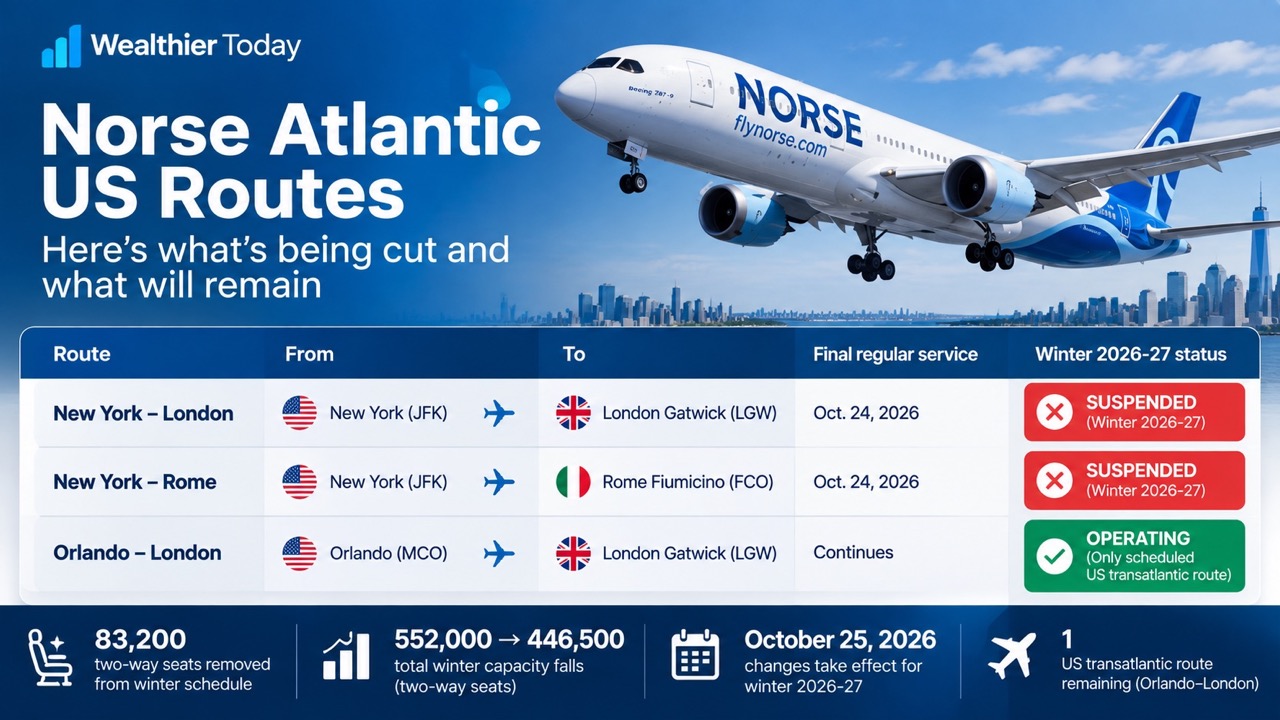
Norse Atlantic Airways is sharply reducing its US presence, with flights between New York's John F. Kennedy International Airport (JFK) and both London Gatwick (LGW) and Rome Fiumicino (FCO) scheduled to end after Oct. 24.
The changes take effect Oct. 25 and will remove Norse's two New York routes from its winter schedule through March 27, 2027. Both services had been scheduled to operate up to three times a week using Boeing 787-9 aircraft.
That will leave London Gatwick-Orlando International Airport (MCO) as Norse's only scheduled transatlantic route to the US during the winter season. The cuts represent a major retreat from the airline's original business model, which centered on low-cost long-haul flights between North America and Europe.
Which Norse Atlantic US Routes Are Being Cut?
AeroRoutes first reported the schedule change on Sept. 22. Its schedule filing shows both New York routes suspended from Oct. 25 through March 27, with each previously scheduled for three weekly flights.
The cuts remove roughly 83,200 two-way seats from Norse's planned winter schedule, according to OAG data cited by Aviation Week. Overall, Norse's planned winter capacity falls from about 552,000 two-way seats to 446,500, with the New York reductions accounting for a significant portion of the decrease.
Norse has already been reducing its US footprint. The airline ended its Los Angeles service earlier this year, while its broader network has increasingly shifted toward leisure destinations outside the US.
For travelers, the immediate impact is concentrated on passengers who had been relying on Norse for nonstop New York-Europe flights. The airline's remaining US service will be the Orlando-London route, which is particularly suited to leisure traffic.
The schedule changes do not mean Norse is abandoning transatlantic flying altogether. Instead, its winter network is becoming much more concentrated around leisure markets where it can deploy aircraft more selectively.
Why Is Norse Atlantic Cutting New York Flights?
The route reductions come as Norse faces higher fuel costs, lower aircraft utilization and a wider financial loss. Norse reported $132 million of revenue in the second quarter of 2026, while its net loss widened to about $70.6 million from $5.9 million a year earlier. The company said elevated fuel prices, lower aircraft utilization and operational disruptions weighed on profitability.
The airline's own Q2 figures showed a very high 97% load factor, but reduced capacity and higher costs still hurt its overall financial performance. Its average fuel price was 1.9 times the year-earlier level, according to the company's earnings-call materials. Norse is also pursuing a cost-reduction program targeting $50 million in annual savings from 2027.
At the same time, the company is conducting a strategic review that could result in a sale, merger or partnership. Norse said in August that multiple parties had signed confidentiality agreements and entered the process.
The airline is increasingly directing capacity toward Thailand. Flights between London Gatwick, Manchester, Oslo and Stockholm and destinations including Bangkok and Phuket account for roughly 313,000 seats during winter 2026-27, or about 70% of Norse's scheduled capacity.
Norse is also preparing for six Boeing 787-9 aircraft to return from an ACMI agreement with IndiGo on Nov. 1. Rather than automatically restoring the New York routes, the airline has indicated that some returning aircraft could be used for Europe-Asia flying, while it is also discussing additional ACMI and charter placements for as many as five aircraft.
The exact commercial reason for each route decision has not been disclosed by Norse. Upgrade Points argued that the airline's low headline fares could become less competitive after passengers added charges for items such as baggage and seat selection, but that is an outside assessment rather than a stated reason from Norse.
The broader shift is clear in the airline's operating numbers. Norse flew 238 scheduled-network flights in August, down from 607 a year earlier, while ACMI and charter flights increased from 52 to 253. CEO Eivind Roald said the company was remaining cautious about capacity while fuel prices stayed elevated.
The retreat also comes against a difficult backdrop for low-cost transatlantic airlines. Norse was created around the idea that inexpensive long-haul flights could attract price-sensitive travelers, but its latest network is increasingly focused on routes where leisure demand and aircraft utilization can support the economics.
For US travelers, Norse Atlantic's New York exit means fewer low-cost nonstop choices to London and Rome, although competing airlines will continue serving both markets. The bigger story is what the changes reveal about Norse itself: the carrier is moving away from its original US-Europe network and toward a smaller, more flexible long-haul operation.