
SpaceX has already become one of the most valuable public companies in the world. Some market watchers now think the stock can go even higher than NVIDIA.
That is the new debate around SpaceX stock, which began trading on Nasdaq under the ticker SPCX after the largest IPO in history. The company priced its IPO at $135 per share, raised about $75 billion, and finished its first trading day at $160.95, according to Business Insider's live IPO coverage. Public trading opened at $150, meaning investors need to separate the IPO allocation price from the first open-market trade.
The current market value is about $2.1 trillion. That is still less than NVIDIA's roughly $4.9 trillion market value, but there are much bigger bullish scenarios: CNBC's Jim Cramer sees a supply-demand setup that could push SpaceX toward $6 trillion, while billionaire investor Ron Baron has discussed a path toward $14 trillion over the next decade if Starlink and orbital AI infrastructure scale.
So, can investors make millions with SPCX? Yes, mathematically. But for most buyers, the answer is less exciting: you would need either a very large starting position, a very long time horizon, or both.
SPCX Price Performance Since Launch: IPO Price, Opening Price and Close
The SpaceX IPO produced three different numbers investors should not mix together:
| SpaceX IPO metric | Price or value |
|---|---|
| IPO allocation price | $135 |
| First public trading price | $150 |
| First-day high | $176.52 |
| First-day close | $160.95 |
| First-day gain from IPO price | 19.2% |
| First-day gain from public open | 7.3% |
| Current valuation after debut | About $2.1 trillion |
That first-day performance matters because anyone who received IPO shares at $135 is already in a different position from investors buying in the open market. The Guardian reported that SPCX closed at $160.95, up about 19% from the IPO price and about 7% from the start of public trading.
For a broader look at what public investors were buying in the IPO, see our earlier breakdown of SpaceX IPO risks and SPCX stock.
Market activity
SpaceX (SPCX)
Market data and charting provided by TradingView. Data may be delayed depending on exchange availability.
What The Expert Targets Mean Per Share
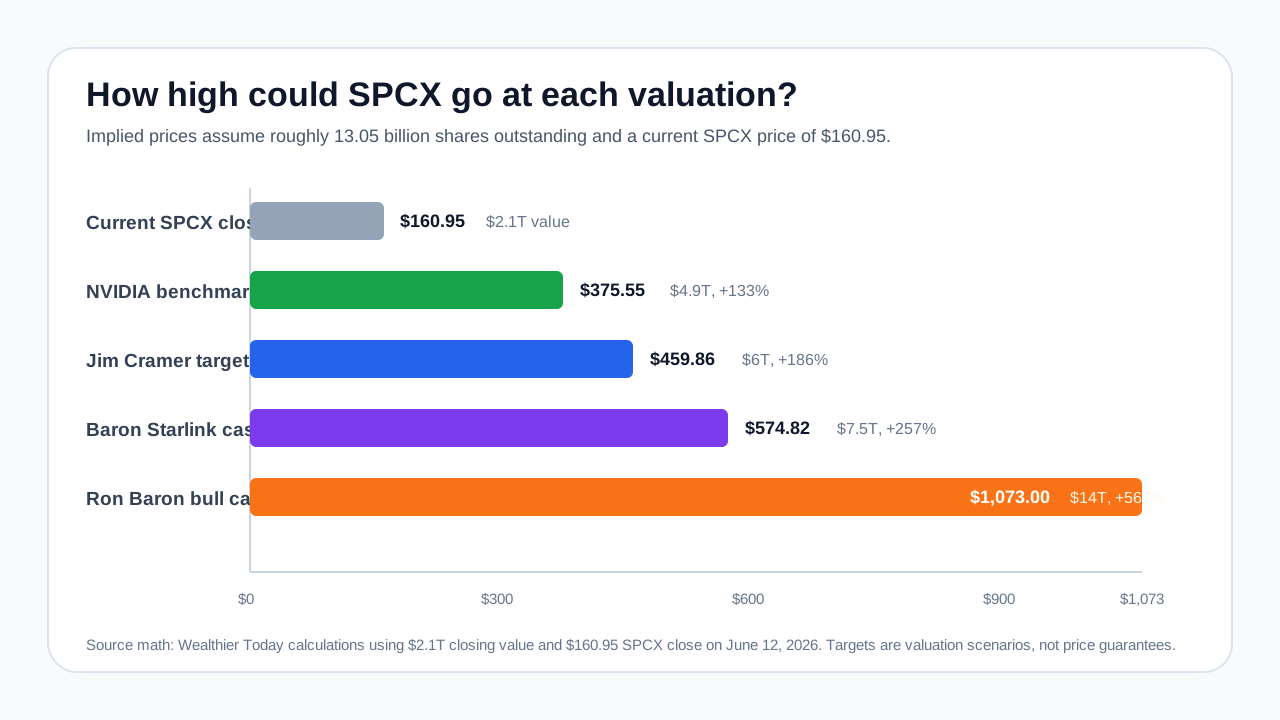
The headline numbers are enormous, but investors buy shares, not market caps. Using the $2.1 trillion closing valuation and the $160.95 closing price implies roughly 13.05 billion shares. If that share count stayed roughly the same, the valuation targets would translate into the following prices:
| Scenario | Valuation | Implied SPCX price | Upside from $160.95 |
|---|---|---|---|
| Current SPCX close | $2.1 trillion | $160.95 | 0% |
| NVIDIA benchmark | $4.9 trillion | $375.55 | 133% |
| Jim Cramer supply-demand case | $6 trillion | $459.86 | 186% |
| Baron Capital Starlink case | $7.5 trillion | $574.82 | 257% |
| Ron Baron bull case | $14 trillion | $1,073.00 | 567% |
These are valuation scenarios, not price targets from a company filing. They also assume the share count does not materially change. Future stock issuance, compensation, acquisitions or buybacks could change the per-share math.
Why Some Experts Think SpaceX Can Pass NVIDIA
The bull case is that SpaceX is not just a rocket company anymore. It is a launch business, a satellite internet business, a telecom infrastructure company and, increasingly, an AI infrastructure story.
The most defensible part of the thesis is Starlink. MoneyWeek reported that Starlink has more than 9,000 satellites and that SpaceX handled more than 80% of licensed U.S. space launches in 2025. The same report noted that SpaceX's IPO valuation already assumed a very large future market, with much of the total addressable market tied to AI rather than traditional space services.
That is why the valuation debate is so extreme. If SpaceX remains mainly a launch and broadband company, the current price is difficult to justify. If SpaceX becomes a dominant global internet provider and an AI infrastructure platform, the bull cases become less impossible, even if they remain highly speculative.
Jim Cramer's argument is more near-term: supply of tradeable shares is limited while demand is intense. That can move a newly listed mega-cap stock faster than fundamentals alone would suggest. The CNBC SpaceX article points to the same post-IPO momentum question.
Ron Baron's case is longer term. MarketWatch reported that Baron expects Starlink to eventually produce about $1 trillion in annual revenue and that Starlink alone could be worth $14 trillion in 12 to 15 years. Barron's separately described a Baron Capital scenario in which Starlink could support a roughly $7.5 trillion valuation by 2036.
Why Their Track Records Matter
Ron Baron has earned attention because he was early and patient with Elon Musk's companies. Business Insider reported that Baron Capital bought about $400 million of Tesla stock between 2014 and 2016 and still held a large position years later. That investment became one of the defining winners of Baron's career.
Baron was also publicly bullish on Tesla before it looked obvious. In 2018, Axios reported that Baron said Tesla could eventually generate $1 trillion in annual revenue and sell up to 15 million cars per year. That exact revenue target is still an open question, but the broader call that Tesla would become a far larger company did come to pass.
His SpaceX credibility is similar: he is not just commenting from the sidelines. Baron has been a major backer of Musk-linked companies, and his firm had meaningful SpaceX exposure before the IPO. That does not make the $14 trillion call guaranteed. It does mean his forecast is tied to a long-running investment thesis rather than a one-day trading take.
Cramer is different. His strength is not long-horizon private-market underwriting; it is market flow, retail enthusiasm and public-company tape reading. Investopedia's profile notes that he is a former hedge fund manager and longtime CNBC host. He has made famous wrong calls and should not be treated as an oracle. But his SpaceX argument is specifically about supply and demand after an IPO, which is closer to his media-market lane than a discounted cash flow model.
One reason to take that part seriously: IPO mechanics can overwhelm fundamentals for a while. Business Insider reported heavy retail demand, major institutional interest and a limited first-day float. That kind of setup can make a stock trade like a scarcity asset before the market gets enough earnings reports to value it normally.
Can You Make Millions With SPCX?
The math is sobering.
If you invested $10,000 at $160.95, the Cramer $6 trillion scenario would turn it into about $28,600. The Ron Baron $14 trillion scenario would turn it into about $66,700. Those are strong returns, but they are not millionaire-making outcomes.
If you invested $100,000, the $6 trillion scenario would be worth about $286,000, and the $14 trillion scenario would be worth about $667,000.
To make $1 million in profit from today's price:
| Target scenario | Approximate shares needed | Approximate cost today |
|---|---|---|
| $6 trillion valuation | 3,346 shares | $538,500 |
| $14 trillion valuation | 1,097 shares | $176,600 |
That is the key point for retail investors. A stock can triple or go up sixfold and still not make you a millionaire unless your starting position is large enough. For most portfolios, SPCX is more realistically a high-risk growth allocation than a one-stock path to financial independence.
If you are thinking about position size, review basic risk and reward, diversification and long-term investing principles before chasing a post-IPO move.
The Bear Case Investors Should Not Ignore
The strongest counterargument is valuation. SpaceX went public around 95 to 100 times sales, depending on the source and timing, while still reporting major losses. MoneyWeek noted that Morningstar valued SpaceX at about $780 billion, far below the IPO valuation, because the AI business carries uncertain economics.
That bearish estimate would imply a price near $60 per share using the same share-count math. Investors do not have to agree with Morningstar, but it shows how wide the valuation range is.
The second risk is that the most exciting parts of the SpaceX story are not proven at public-company scale. Starlink has real customers and real revenue. Space-based AI data centers, asteroid mining and Mars infrastructure are far more speculative.
The third risk is dilution and capital intensity. SpaceX raised $75 billion, but the company's ambitions require enormous spending. If the company issues more shares, today's per-share upside to any future valuation target could be lower.
The fourth risk is timing. Even if Baron is right about the long-term direction, stocks can fall sharply between the IPO and the eventual payoff. New public companies often face lockup expirations, insider selling, index rebalancing and the first real test of quarterly earnings expectations.
Bottom Line
It is possible SpaceX may eventually surpass NVIDIA's $4.9 trillion valuation. The Cramer case says scarcity and demand could push SPCX toward $6 trillion faster than skeptics expect. The Baron case says Starlink and orbital AI infrastructure could someday justify numbers as high as $14 trillion.
But investors should translate those market caps into share prices before buying the headline. At $160.95, a $6 trillion SpaceX would imply roughly $460 per share, while a $14 trillion SpaceX would imply about $1,073 per share. That is huge upside, but it is not magic. Making millions would require a large position, and taking a large position in a newly public, highly valued, still-speculative company is not the same thing as finding a sure winner.
For now, SPCX is one of the most important stocks in the market. It is also one of the hardest to value.