
Anthropic has become the latest flashpoint in the U.S. government's fight over frontier AI, after a new order forced the company to cut access to two of its most important products: Claude Fable 5 and Claude Mythos 5. The move matters because it turns a policy debate into a product shock.
Fable 5 was released only days earlier as Anthropic's most powerful generally available model, while Mythos 5 was positioned as a more restricted version for trusted users. Now both are caught in a government action that could reshape how OpenAI, Google, xAI, Meta and other AI labs release their most capable systems.
What Happened To Anthropic's AI Products?
Axios reported that the Trump administration imposed export controls on Anthropic's Mythos 5 and Fable 5 models, treating the systems as national security-sensitive assets. The order reportedly bars access by foreign governments, companies and individuals without a license. The restriction includes foreign nationals inside and outside the United States, including foreign-national employees. Anthropic said the practical result was that it would disable access for customers to make sure it complied with the order.
However, Anthropic disputed the government's justification, saying it had not received detailed evidence of a unique national security problem. The company said the concerns appeared to involve potential jailbreaks, but argued that the disclosed issues were narrow and not specific to Mythos.
The company reportedly took the models offline to comply with the directive while expressing disagreement with the government's handling of the issue.
Which Anthropic Products Were Hit?
The two products at the center of the order are Fable 5 and Mythos 5. Fable 5 was the public-facing product, described as Anthropic's first broadly available Mythos-class model, built for software engineering, knowledge work and vision tasks. The model reportedly cost $10 per million input tokens and $50 per million output tokens, double the rate of Claude Opus 4.8.
Mythos 5 was the more sensitive product. It was described as the same underlying model as Fable 5 but with safeguards lifted in some areas, with access limited to select organizations through Anthropic's trusted-access efforts.
That distinction is important for investors and enterprise buyers. Fable was the revenue-facing product that could expand usage across teams, while Mythos was the strategic capability product that could help Anthropic compete for high-value cybersecurity, infrastructure and government-adjacent customers.
Why The Government Is Focused On These Models
The most likely policy issue is not ordinary chatbot output, but whether frontier models can help users find vulnerabilities, accelerate cyber operations, or assist with dangerous scientific work. That is why the Fable and Mythos launch came with unusually visible guardrails. The model family was described as powerful enough that Anthropic restricted certain cybersecurity, biology and chemistry requests. Some sensitive requests were routed to a less capable model instead.
Axios later reported that Amazon security research and discussions with the White House contributed to the government's response. The same report said the letter was directed at Anthropic alone, but industry observers saw broader implications.
For the AI industry, this is the key point: the government did not only restrict chips, data centers or overseas sales. It restricted access to the model capability itself.
Usage Data Shows Why The Stakes Are Bigger
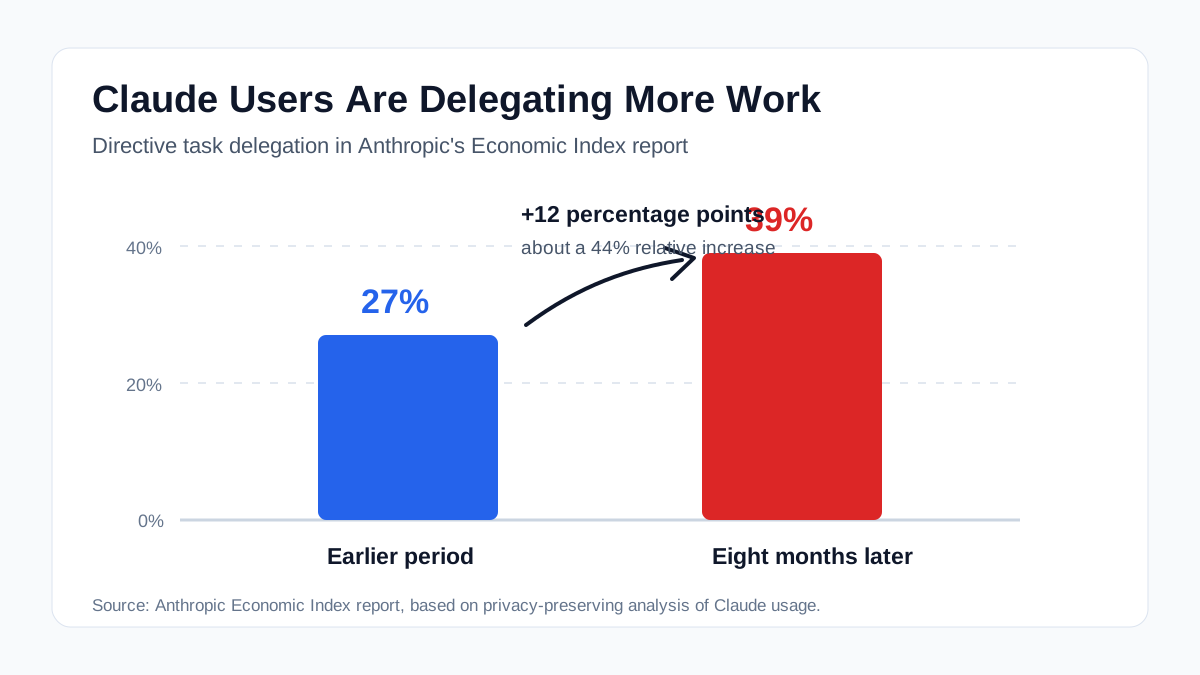
Anthropic's Economic Index report shows why a model-access fight can ripple through the economy. The report analyzed 1 million Claude.ai conversations and 1 million API transcripts across more than 150 countries. It found that directive task delegation rose from 27% to 39% over eight months. That shift means users are not only asking AI for help. More of them are asking AI systems to complete work.
The same report found that Claude usage is geographically uneven, with wealthier countries overrepresented relative to their working-age populations. That makes export controls more than a legal issue. If access to the most capable models becomes nationality-based, geography could become an even bigger factor in who gets the productivity upside of AI.
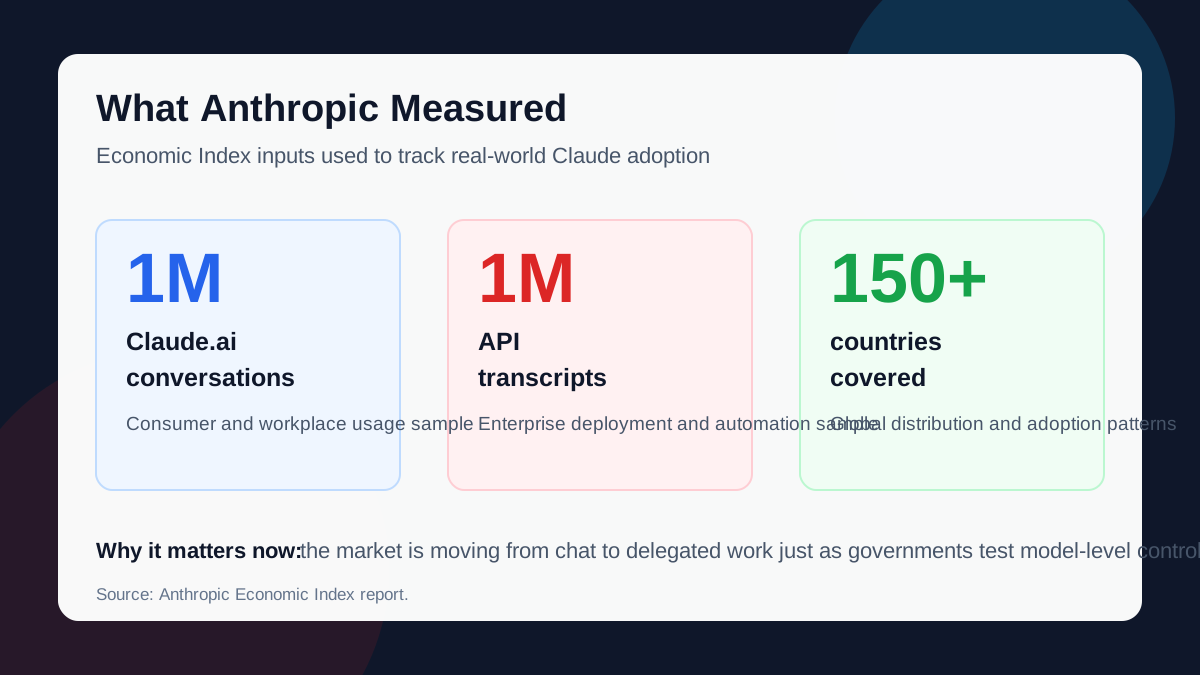
This is where the Anthropic order connects to the broader AI boom. AI labs are racing to turn models into enterprise automation platforms. Businesses are racing to use them for coding, research, support and analysis. Governments are trying to decide whether those same systems are productivity tools, dual-use infrastructure, or something closer to strategic technology.
What This Could Mean For Other AI Companies
The immediate order hit Anthropic, but the precedent could reach the rest of the frontier AI market. First, AI companies may have to build export-control compliance into products, not just sales contracts. If model access can be restricted by nationality, companies may need stronger user verification, employee access controls, audit trails and customer segmentation.
Second, the most capable models may increasingly ship through tiered access. Public models could be more restricted, while less-guarded versions are reserved for vetted customers, researchers or government-approved partners. That would make "who gets the best model" a competitive question and a compliance question.
Third, cloud partners could become part of the risk surface. If outside security research can trigger federal action, companies selling AI through Microsoft Azure, Amazon Web Services, Google Cloud or enterprise platforms may need clearer rules for vulnerability disclosure and escalation.
Fourth, investors may start discounting AI revenue that depends on unrestricted global access. A model can be technically superior and still lose commercial value if major customers, foreign staff or international subsidiaries cannot use it.
That matters for anyone watching AI-adjacent stocks. The lesson is similar to the risk framework we use in our guide to risk and reward: a fast-growing asset can carry hidden downside if investors underestimate regulation, concentration or execution risk.
Why This Is A Bigger Issue Than Anthropic
The U.S. has already restricted advanced semiconductor exports because chips are a strategic input for AI. This order points at the next layer: the model outputs themselves. If Washington treats frontier AI models as export-controlled technology, several consequences follow.
- AI labs may slow down or narrow public releases of their most powerful systems.
- Enterprise customers may demand contractual protection if government orders interrupt access.
- U.S. allies may push for licensing arrangements so their companies and researchers are not locked out.
- Foreign governments may accelerate domestic model development to avoid U.S. dependency.
- Open-source model debates may intensify if closed models face stricter controls than downloadable weights.
This does not mean every AI company will face the same order. The government's concern appears focused on advanced capability, national security and access by foreign nationals. But it does mean other AI labs now have to assume that a product launch can become a government-access decision very quickly.
Anthropic's Response to the US Government's Directive
Anthropic later published its own statement on the government directive, giving more details on how the company sees the dispute. The company said it received the directive at 5:21 p.m. ET on June 12, 2026. According to the company, the order cited national security authorities and required the company to suspend all access to Fable 5 and Mythos 5 by any foreign national, including foreign-national Anthropic employees inside or outside the United States.
Anthropic said that made a narrower customer-by-customer restriction impractical. To comply, it said it had to disable Fable 5 and Mythos 5 for all customers, but the company added that access to its other models would not be affected.
The statement also pushed back on the government's apparent reasoning as it said the directive did not include specific details about the national security concern, but that the company understood the issue to involve a possible way to jailbreak Fable 5. It also stated that it reviewed a demonstration of the technique and believed it was used to identify a small number of previously known, minor software vulnerabilities.
Anthropic argues that the disclosed issue does not show a unique or catastrophic capability gap. In fact, other publicly available models could find similar vulnerabilities without using the same bypass, and the evidence it had seen pointed to a narrow, non-universal jailbreak rather than a broad failure of the model's safeguards.
The company also defended its pre-launch testing as Fable 5 had been red-teamed for thousands of hours by internal teams, private third parties, the U.S. government and the U.K. AI Security Institute. It said testers had not found a universal jailbreak that broadly bypassed the model's safeguards, and that its approach relied on defense in depth, monitoring and customer-data retention to detect and mitigate misuse.
At the same time, it was complying with the legal directive while disagreeing with the action. The company argued that recalling a commercial model over a narrow potential jailbreak would create a standard that could effectively halt new frontier model deployments across the industry. However, they are working to restore access as soon as possible.